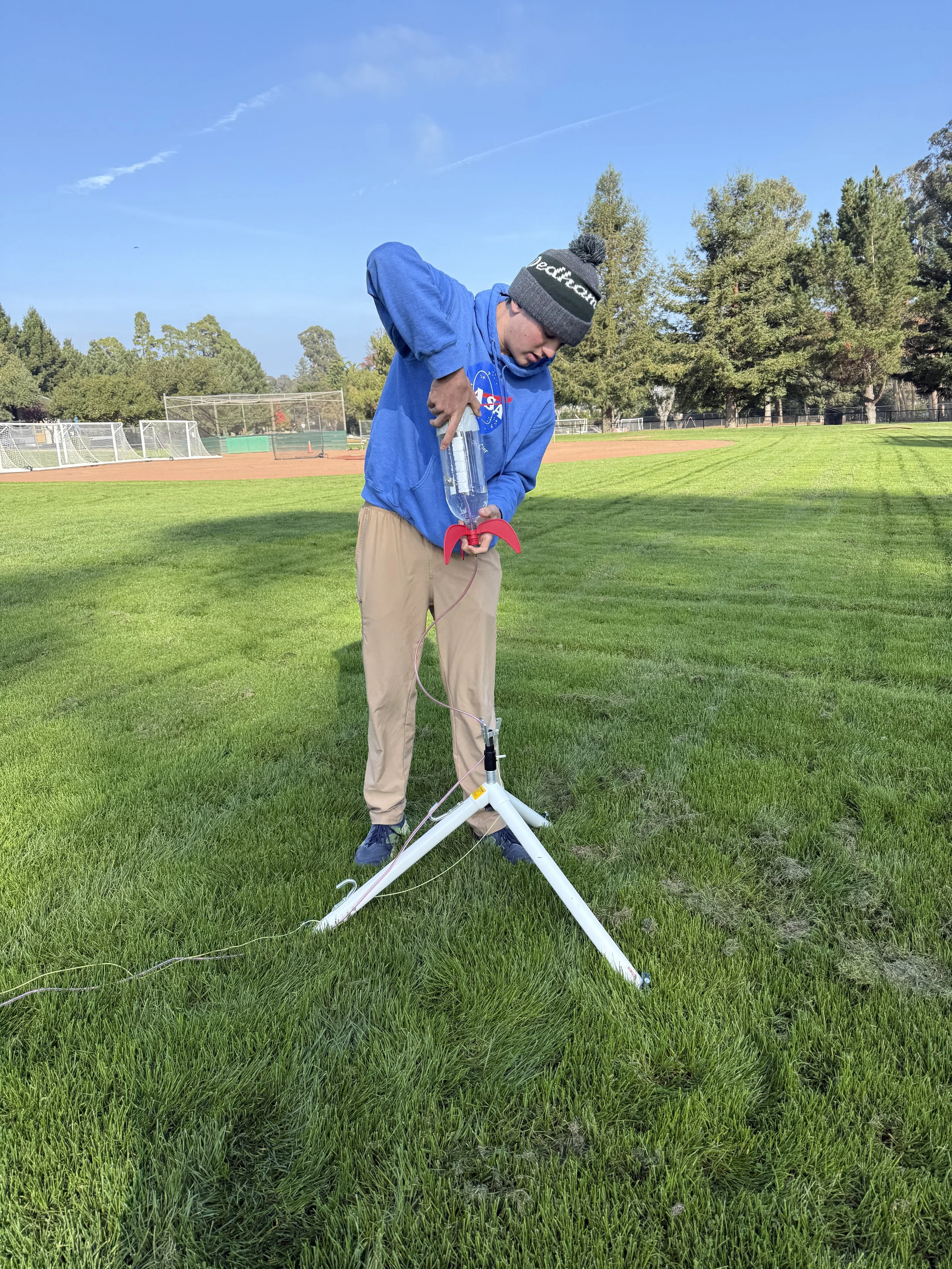
Model Rocketry
For the past five years, I have designed and built air-pressurized water rockets with custom autonomous parachute deployment systems, in an attempt to reach new personal best altitude records while stretching my math, science, and engineering knowledge and growing as a learner and problem solver. I began developing my parachute deployment system in seventh grade, with a rudimentary micro:bit-controlled servo deployment mechanism, surrounded by a 3D-printed aeroshell.
I evolved this system during freshman year with my self-taught knowledge of Autodesk Fusion 360. I custom-designed a new aeroshell and deployment mechanism, along with a custom Arduino-gyroscope sensor circuit responsible for deploying the parachute. After several iterations and crashes, I landed on a lightweight design that consistently deployed a parachute after apogee.
I then explored custom fuselage designs. I achieved a peak altitude of 254 feet with a custom spliced fuselage. I also designed a rocket launcher to operate at higher launch pressures, resulting in a new personal record of 401 feet. Next, I wrapped fuselages in fiberglass to increase their maximum pressure capabilities. Despite three burst fuselages, I eventually made a fuselage of about 4.5 liters capable of withstanding 270 psi of internal pressure. This design holds my current personal record of 463 feet.
Currently, I am teaching myself computational fluid dynamics in the open-source software OpenFOAM to mathematically model air-pressurized water rocket exit velocity and predict rocket altitude. I hope to use these models to optimize fuselage geometry. I am in the process of writing a paper on this research and its educational applications, which I plan to submit to arXiv.