Model Rocketry
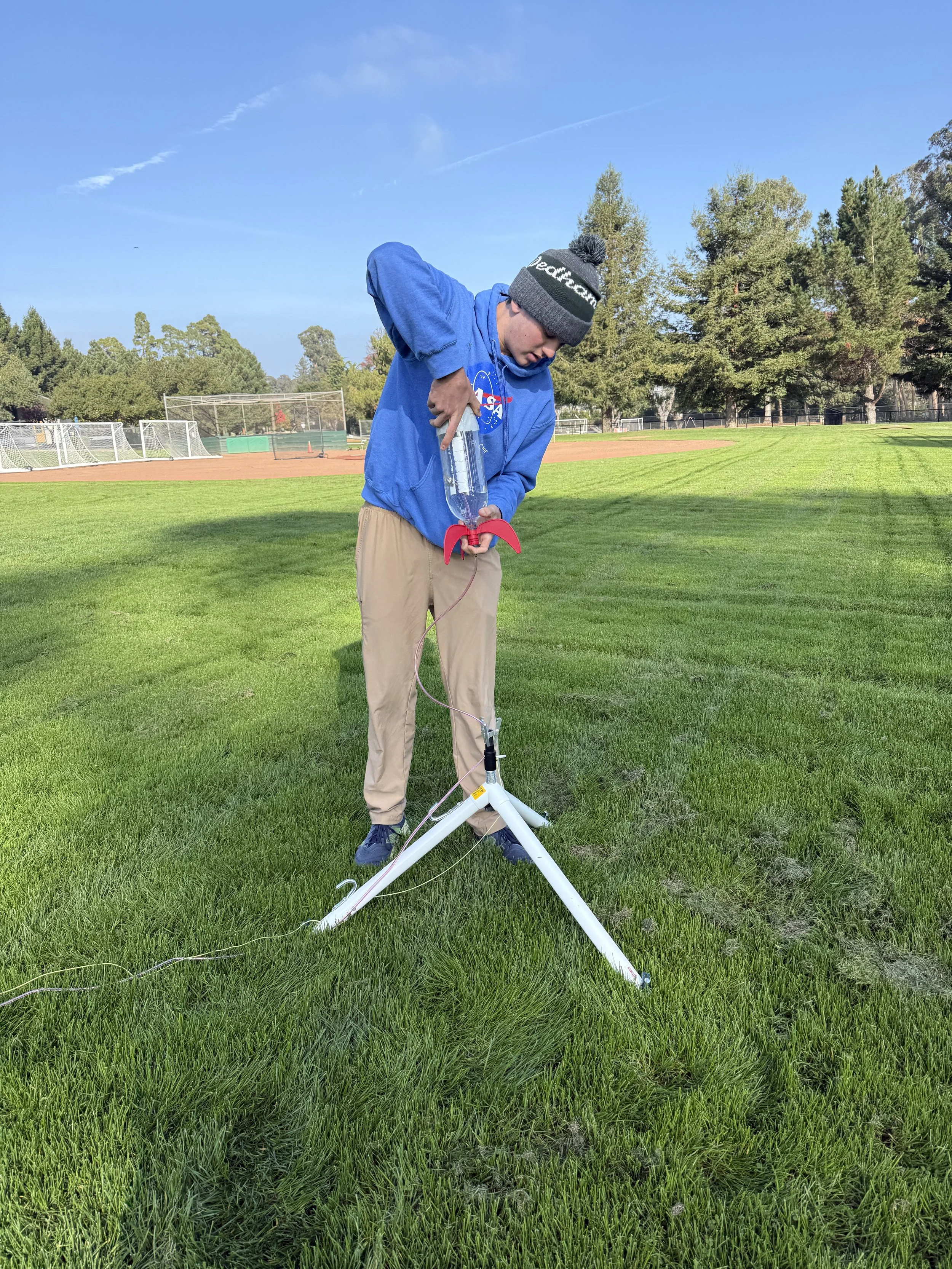
For the past five years, I have designed, built, and mathematically modeled compressed-air and water rockets with custom autonomous parachute deployment systems, in an attempt to reach new personal best altitude records while challenging my math, science, and engineering knowledge to grow as a learner and problem solver. My parachute deployment system development began in seventh grade, with a rudimentary micro:bit-controlled servo deployment mechanism, surrounded by a 3D-printed aeroshell.
I evolved this system over the summer heading into sophomore year with my self-taught knowledge of Autodesk Fusion 360. I custom-designed a new aeroshell and deployment mechanism, along with a custom Arduino-gyroscope sensor circuit responsible for deploying the parachute. After several iterations and crashes, I landed on a lightweight design that consistently deployed a parachute after apogee.
I then explored custom fuselage designs. I achieved a peak altitude of 254 feet with a custom spliced fuselage. I also designed a rocket launcher to operate at higher launch pressures, resulting in a new personal record of 401 feet. Next, I wrapped fuselages in fiberglass to increase their maximum pressure capabilities. Despite three burst fuselages, I eventually made a fuselage of about 4.5 liters capable of withstanding 270 psi of internal pressure. This design holds my current personal record of 465 feet.
Currently, I am teaching myself computational fluid dynamics in the open-source software OpenFOAM to mathematically model water rocket exit velocity and predict rocket altitude. I hope to use these models to optimize fuselage geometry. I am in the process of writing a paper on this research and its educational applications, which I plan to submit to arXiv.