Composite Fuselages
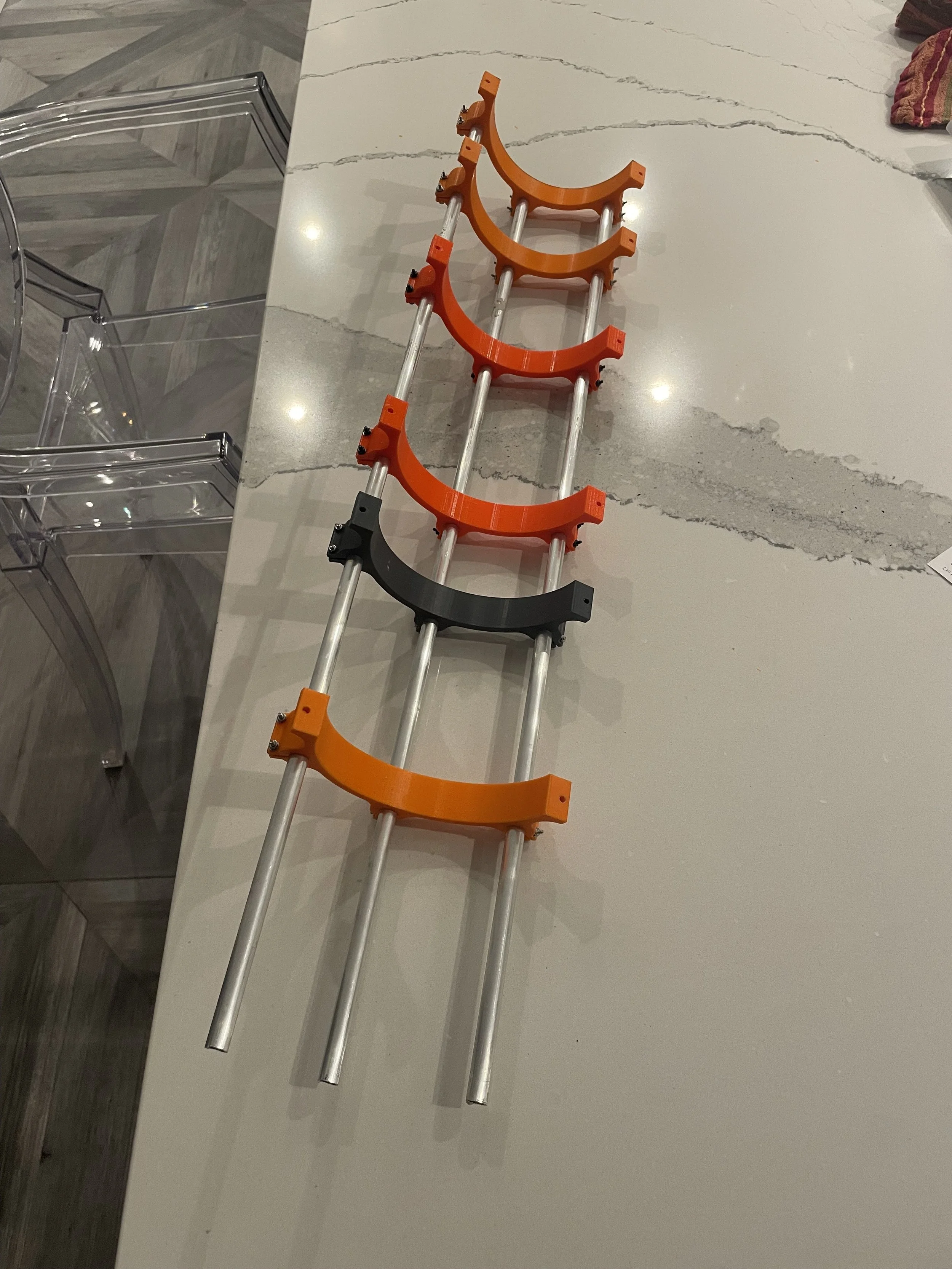
After my parachute deployment system proved effective and reliable, I decided to push for personal altitude records. Increasing fuselage size is one method of achieving greater altitudes. To increase the size of the rocket fuselage, I decided to combine multiple soda bottles into one hull. To do this, I designed a splicing jig. It consisted of long aluminum rods attached to circular plastic clamps. I found the aluminum rods at my school’s iLab and designed and 3D-printed the clamps. This device enabled me to align 2-liter soda bottles while I spliced them together to form larger vessels. A typical spliced joint between two 2-liter bottles produces a 3-liter vessel. With a basic splice, Version 3 of the parachute deployment system, and a launch pressure of 65 psi, I reached an altitude of 254 feet.
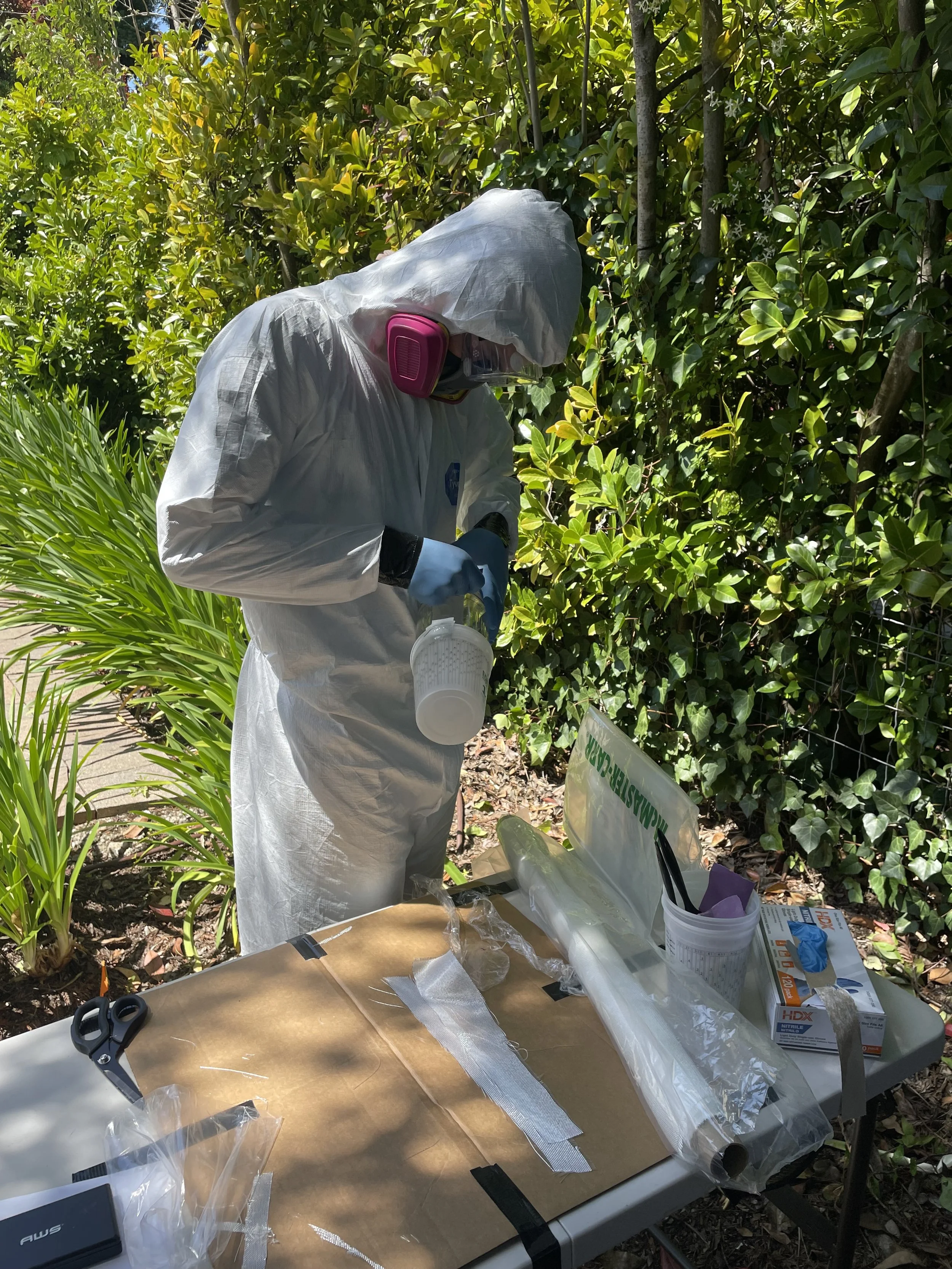
Following that personal altitude record, I wanted to launch the spliced fuselages at higher pressures. A standard 2-liter soda bottle can withstand about 120 psi of launch pressure. Pressures higher than that become unsafe. The bottle could explode on the launch pad and cause damage or injury. For this reason, while I continued to use the fuselage from my most recent 254-foot altitude launch, I increased the launch pressure only slightly, to 70 psi. At 70 psi, however, the fuselage had a tendency to leak air at the seam. I researched epoxy resin and fiberglass to learn how to reinforce the spliced joint with composite layups. Ultimately, I used one layer of 4 oz fiberglass cloth and epoxy resin to seal the spliced joint. This, along with my custom-built high-pressure launcher, allowed me to launch at 120 psi and reach a record altitude of 401 feet.
After this success, I began wrapping an entirely new 3-liter pressure vessel in one full layer of fiberglass. There were many mistakes throughout this first fiberglass layup, and I found it difficult to make the fiberglass contour to the curved end of the fuselage and the tight contraction of the nozzle. With time and practice, I developed techniques to improve my layup skills, such as applying a small amount of resin before applying the fiberglass, which made it easier to stick the fiberglass cloth in place.
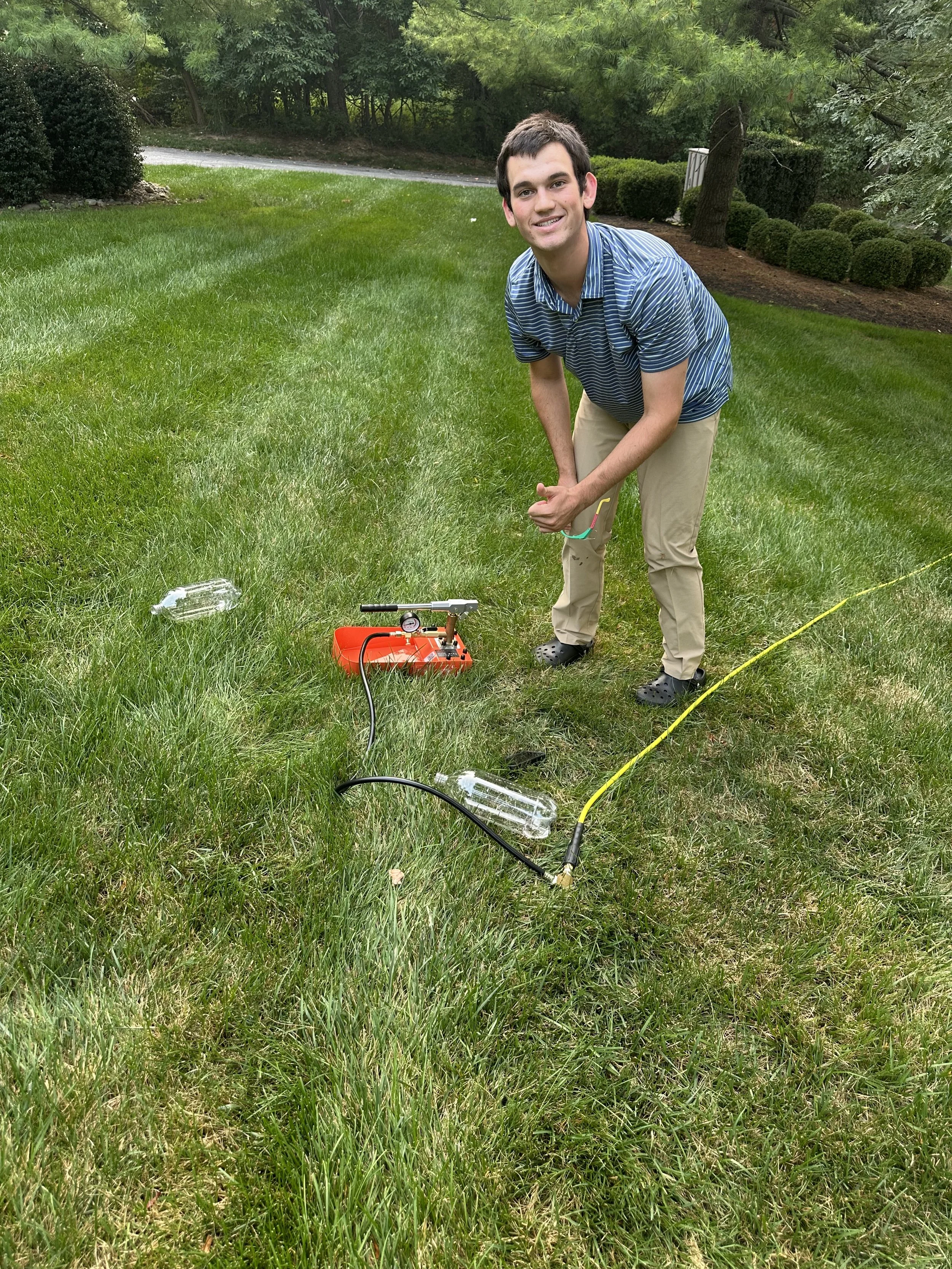
During the pressure test, I employed a new testing procedure. Previously, I had mounted all rockets onto my launcher for air-pressure tests. This method is very dangerous because air is highly compressible, so a rupture could turn into an explosion. For these new tests, I used a hydrostatic test pump. Water is incompressible, so pressure-vessel bursts result in leaks instead of explosions. Hydrostatic testing is standard industry practice. With one layer of 4 oz fiberglass, the new fuselage burst at 190 psi.
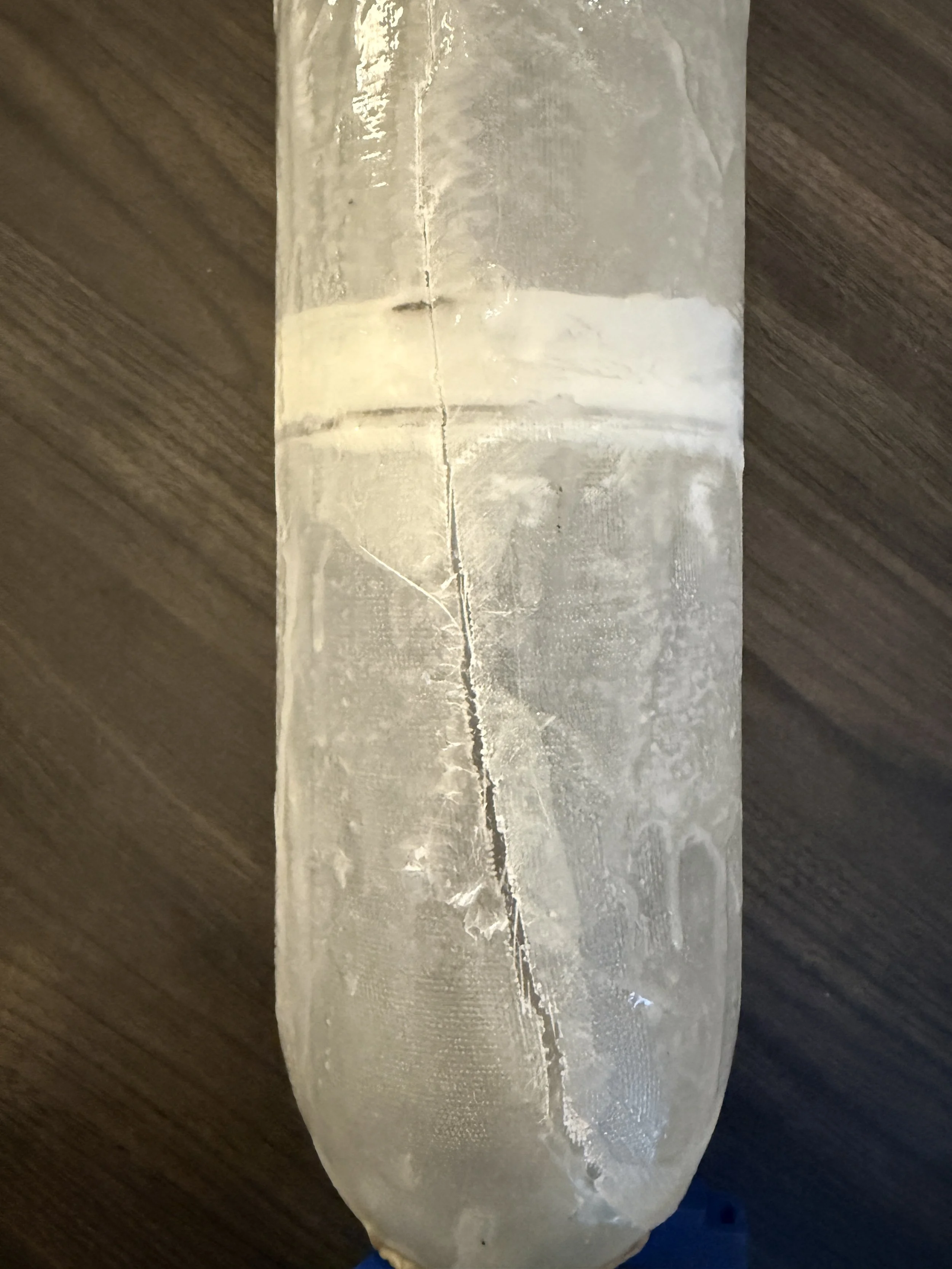
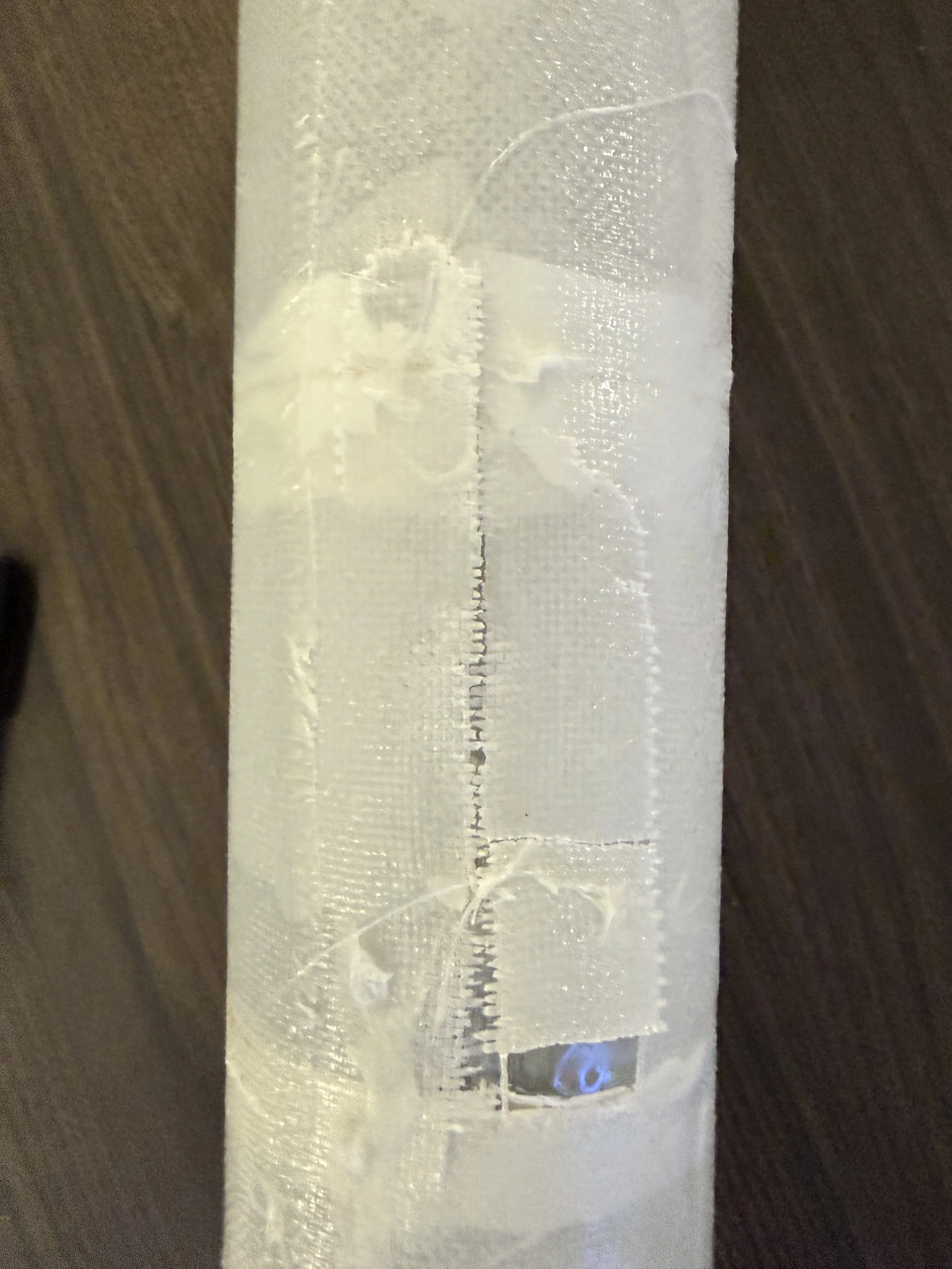
To achieve a launch pressure higher than 190 psi without the fuselage bursting, I began work on a new fuselage design using stronger 10 oz fiberglass cloth. This cloth was much stiffer and heavier to work with, but I developed new layup techniques during the manufacturing process. I spliced together four 2-liter soda bottles for an estimated fuselage capacity of 6 liters—my largest fuselage to date. However, it also burst, this time at 290 psi. As in the previous test, the fuselage burst when the fiberglass fibers snapped. I needed to reconsider my fiberglass selection once again. I was targeting a launch pressure of 270 psi, which requires at least 50 psi of safety margin. Therefore, it would have to hold 320 psi. The video to the left is of the pressure test, and the “pop” sound corresponds to the fuselage rupture, visible when the gauge drops to zero.
I had two options after this pressure test. I could either search for a different weave of cloth or build a new fuselage wrapped in two layers of 10 oz cloth. I chose to use the 10 oz cloth I had on hand, but I am now actively exploring other cloth weaves. Biaxial cloth is a well-known weave that distributes loads better across its two axes and is preferred for a pressure vessel like mine.
When double-wrapped, the pressure vessel still failed at 290 psi. However, this time, the thick unreinforced plastic neck of the bottle burst at this pressure, not the fiberglass weave. It is not feasible to reinforce that portion of the neck, so I determined that to reach any pressures higher than 290 psi, I would need to design a fully custom fuselage.
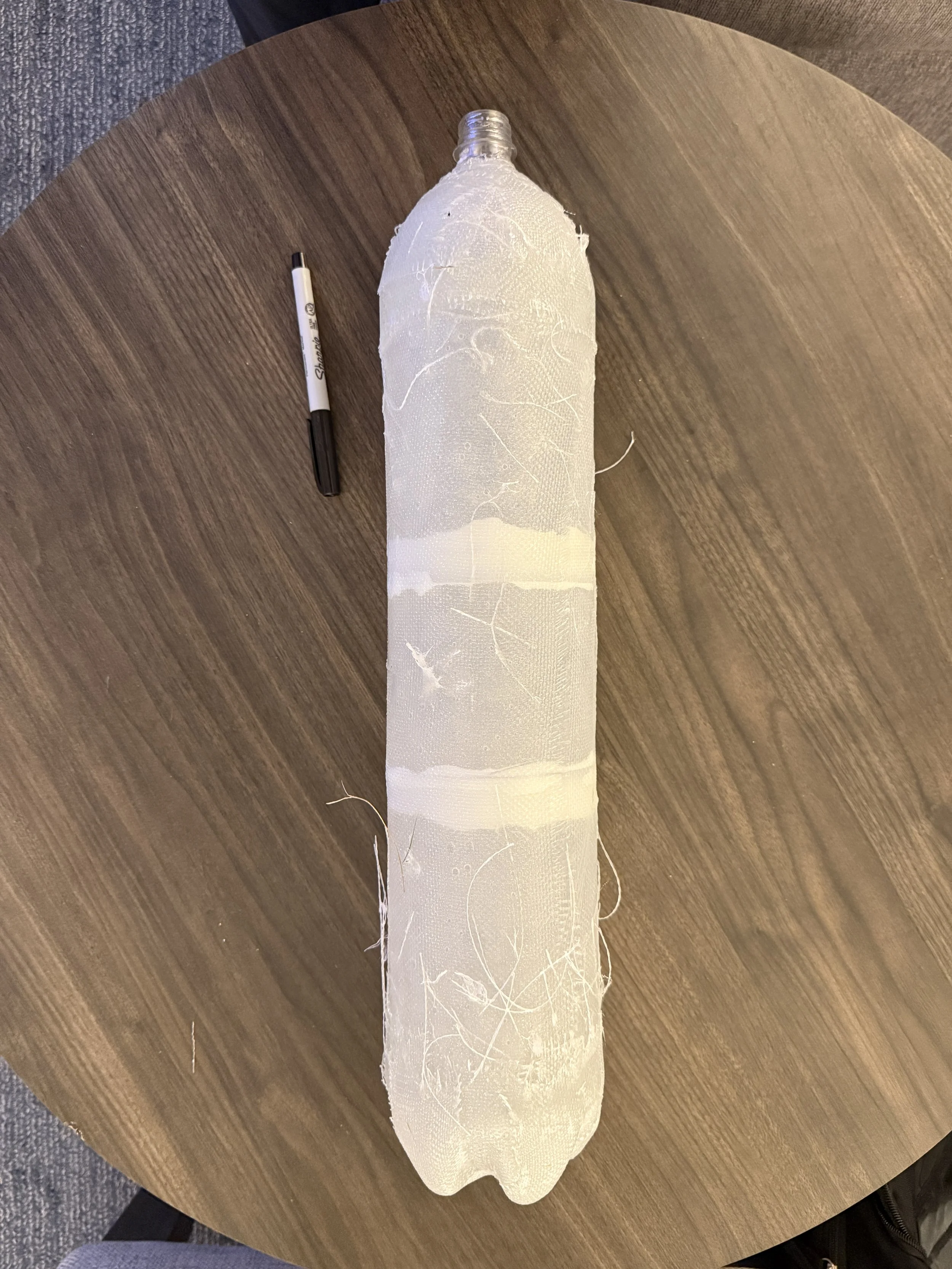
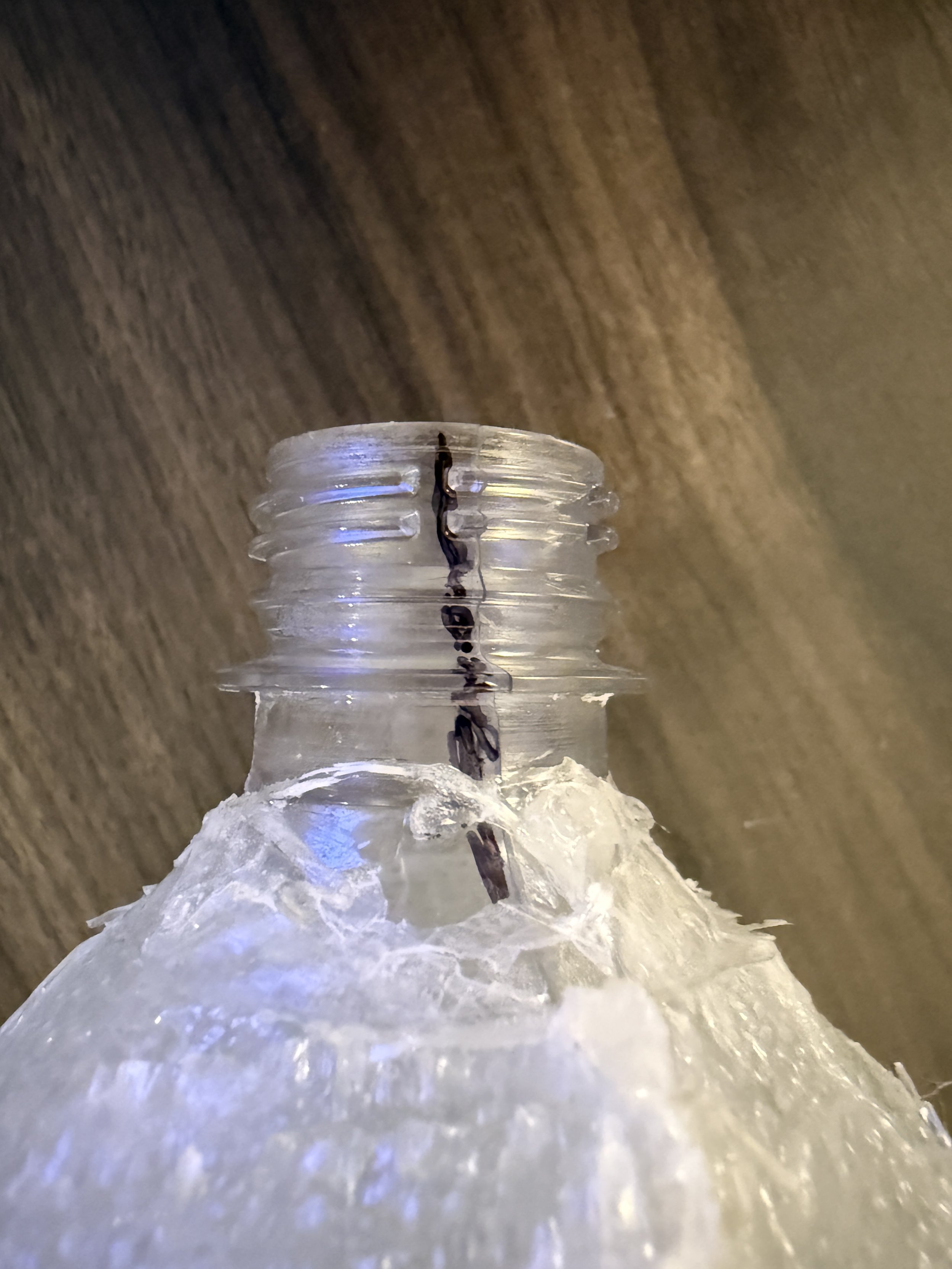
To produce a fuselage capable of preliminary model-verification test flights, I decided to build one more 10 oz fiberglass fuselage with roughly 4.5 liters of internal capacity, but pressure-test it only to 270 psi. This fuselage held for multiple pressure cycles, including two one-minute holds at 270 psi. This exceeded my expectations. Factoring in my 50 psi safety margin, these test results meant that I could launch at up to 220 psi with this fuselage. On its first launch, this rocket encountered issues with the launch clamps, yet still flew to a new record of 465 feet.
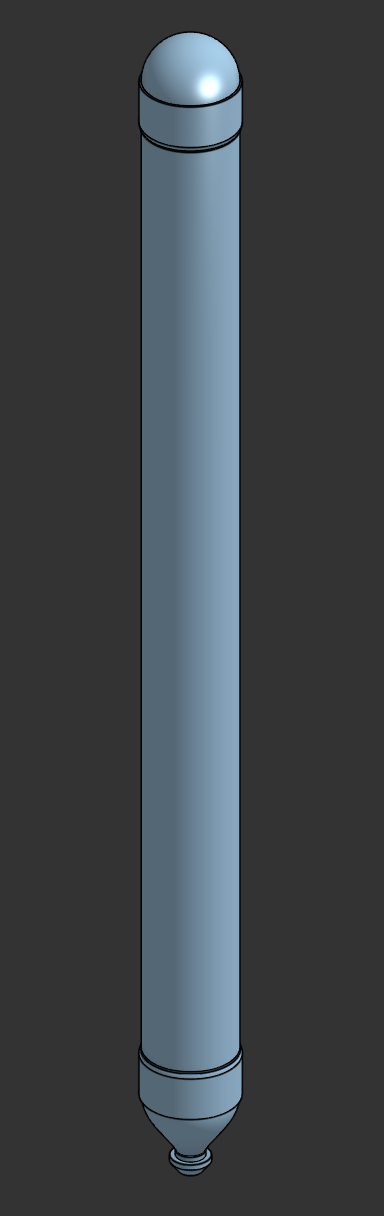
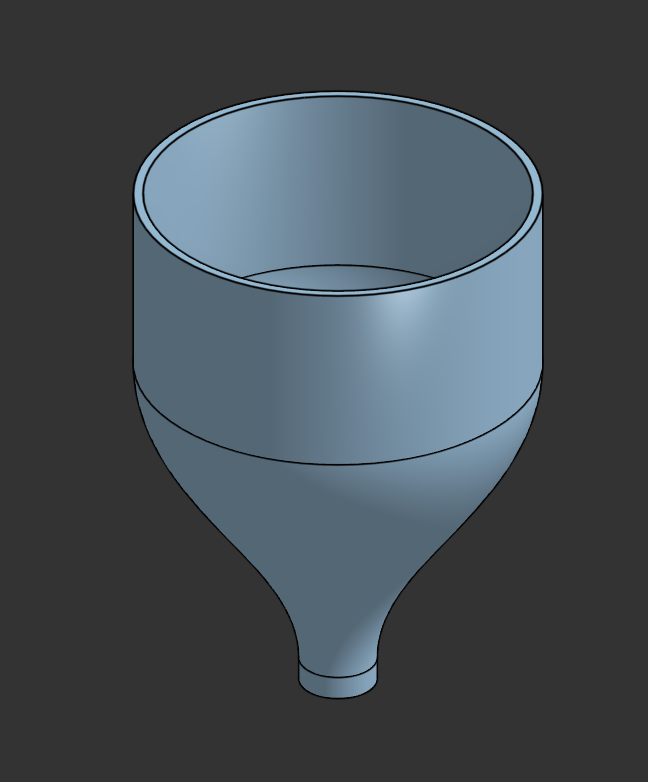
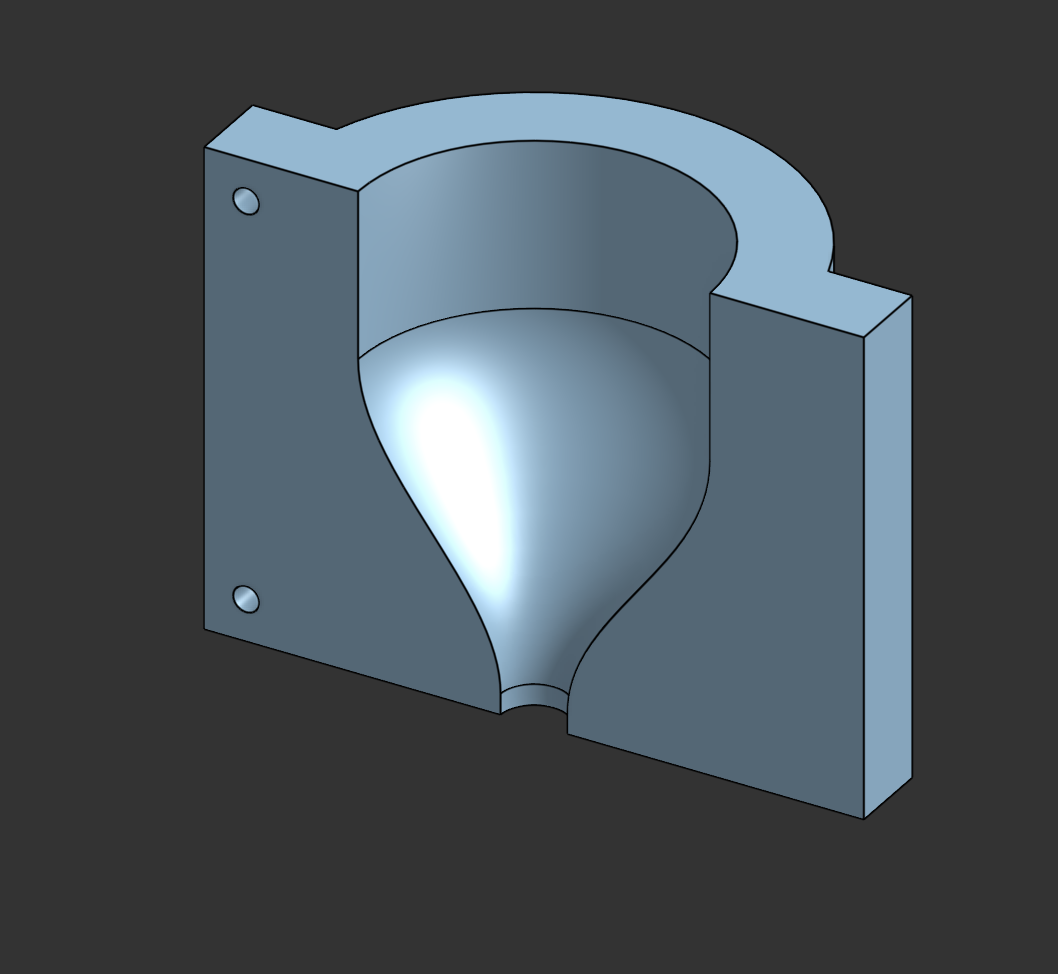
For my next rockets, I plan to build fully custom fuselages, with various parameters determined by my mathematical models. Those parameters include fuselage diameter, number of fiberglass layers, nozzle diameter, and nozzle contraction geometry. I plan to use 3D-printed molds to form the fiberglass composites into these custom shapes. I also plan to use woven fiberglass sleeving that can withstand pressure loads better than standard plain-weave cloth. My initial designs for some of the fuselage components are pictured in the first two images to the right. My initial mold design is pictured in the far-right image.